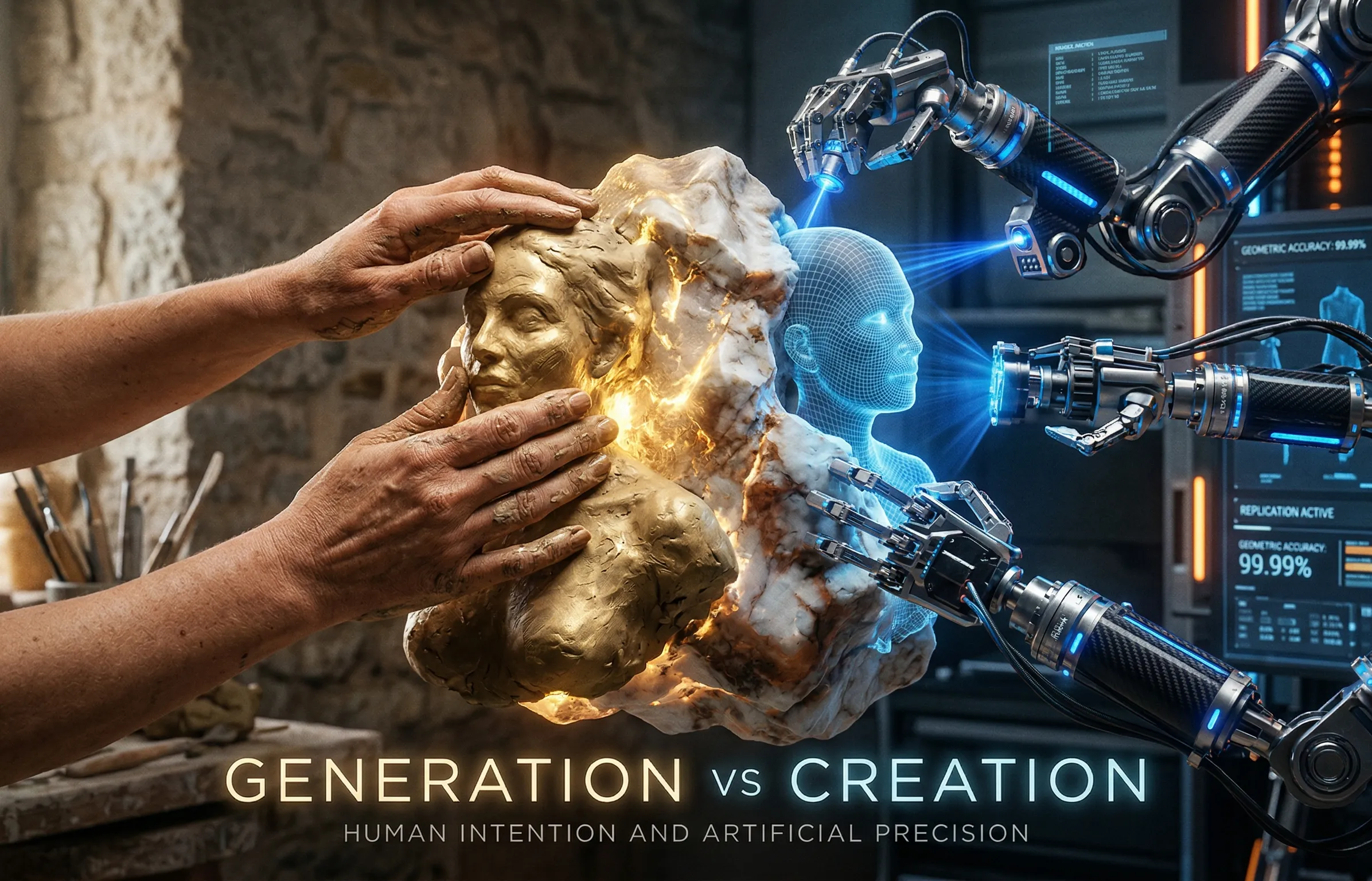
A lot of people describe this AI moment as a productivity shift. That is true.
But I think the deeper shift is this: AI is changing not only how products are made, but the mechanism by which value is formed in the first place.
That is a much bigger change than “startups are getting harder.”
The Old Logic of Value Creation
For most of the internet era, value creation followed a relatively stable logic:
- Find a clear user need.
- Build a product that solves it.
- Scale through execution, distribution, and network effects.
This is why the YC playbook worked so well for so long. “Make something people want” was not just good advice — it matched the structure of the market.
- Demand was assumed to be there.
- Users more or less knew what they wanted.
- Product capability itself was still scarce.
The company that built faster, iterated better, and distributed more effectively usually won.
AI Is Destabilizing All 3 Assumptions at Once
The problem is not that demand has disappeared. It is that supply has exploded, while demand itself has become unstable.
1. User demand is getting harder to freeze into a fixed product form
What people want today may look like a tool. Tomorrow it may look like an agent. The day after that, they may not want your product at all — only the outcome.
AI does not merely satisfy demand. It keeps rewriting what demand looks like.
2. Product capability is becoming fluid public infrastructure
What used to be a defensible feature now feels temporary. Today’s breakthrough feature becomes tomorrow’s model capability, and the day after that becomes a platform default.
This is why so many founders feel anxious right now. Not because they cannot build — but because they know what they build may not compound into long-term value.
3. Competition is shifting from solving problems to defining which problems matter
This is the real shift. The strongest companies of the next era may not be the ones that build the fastest. They may be the ones that answer deeper questions better:
- What problems are worth solving for the long term?
- Which users will keep paying for a particular point of view?
- What kinds of experience, identity, taste, and relationships are worth preserving rather than absorbed into a generic agent layer?
The New Competitive Landscape
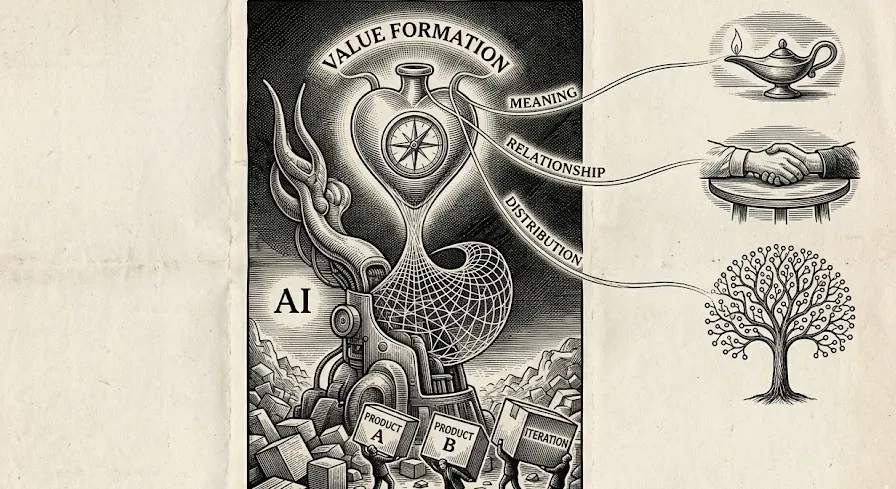
I do not think the shift is simply from function to culture. A better description is this:
Competition is moving from pure efficiency-based competition to a mix of meaning-based competition, relationship-based competition, and distribution-based competition.
It becomes an existential question: What world are you trying to create, and for whom?
Layer 1: Meaning
This is why “deeper intention” suddenly matters more. Not because culture is magic. Not because morality replaces execution. But because in an environment of overwhelming possibility, only people with strong internal direction can avoid paralysis.
Layer 2: Relationship
In a world where agents can replicate functionality, they still struggle to replicate social structure. They can copy workflows, imitate tone, and reproduce interfaces. But they cannot easily reproduce:
- Why a certain group of people wants to gather around a product in the first place
- Trust, shared language, brand intimacy, or a founder’s credibility with a specific community
That means many AI-era products may increasingly function as relationship containers disguised as software. On the surface, they sell utility. Underneath, they accumulate trust, belonging, reputation, identity, and shared taste.
This is also why content, community, and narrative are no longer just marketing add-ons. They are becoming part of the product itself.
Layer 3: Distribution
This may matter even more than many people realize — because AI is not only flattening product differentiation but also recentralizing access.
If more user needs are mediated by ChatGPT, Claude, OS-level agents, or enterprise workflow layers, then the challenge for independent products is not just that their features can be copied. It is that users may no longer reach them directly at all.
In that world, the question changes: you are no longer only competing for users. You are competing to be surfaced, invoked, remembered, recommended, and explicitly trusted.
That raises the importance of brand and personal credibility from “nice to have” to infrastructure-level importance.
For many products, the core question becomes: Are you the name users remember, type in, ask for, and trust on purpose?
From Producing Products to Producing Consensus
This is why I think the deeper summary of the AI shift is the following:
AI is inflating manufacturing capability, so the center of entrepreneurship is moving from producing products to producing consensus.
Whoever produces consensus gets pricing power, distribution power, and organizational gravity. That consensus can take many forms:
- What users believe a good product is
- What they see as worth integrating into their workflow
- Which brand they trust to interpret the future
- Which company becomes the category reference point
The Founder of the Next Era
From this perspective, the founder of the next era looks less like a pure builder and more like a hybrid of three roles: builder, editor/curator, community architect.
Not just someone who makes tools, but someone who selects what matters, organizes people around it, and gives the market a standard to believe in.
Technology is still essential, but it no longer explains enough on its own. Engineering strength remains the price of admission in the AI era: without it, you cannot build at the necessary speed or quality. But once that threshold is met, the game is no longer decided by technical ability alone. The harder question is whether what you build can hold attention, earn trust, shape behavior, and occupy a meaningful place in people’s lives once functionality itself becomes easier to replicate.
The strongest companies will likely combine four things at once:
- Enough underlying capability to absorb model progress quickly
- A smooth enough product experience to own a real use case
- A distinct enough brand/community to create emotional stickiness
- A credible enough founder narrative that people want to follow it
All four matter now.
The Scarcest Asset
So yes, in one sense, people may increasingly follow people rather than functions. But I would put it slightly differently:
In an age where functionality is rapidly commoditized, users ultimately follow credible judgment.
That judgment can live in a founder, a brand, a community, a product philosophy, or a shared aesthetic.
Because in the end, people are not just buying tools. They are buying a sense of who understands the world, who helps them choose, and who makes them feel aligned with the right future.
That may be one of the scarcest assets in the AI era.